
 English
 русский
 Français
 Español
 Deutsch
 عربى
عربى


How to Calculate How Much Wallpaper I Need: Count Drops, Not Square Meters
Content
The label says a roll covers about 5.3 square meters. The room measures 48 square meters. Nine rolls go on the order, and three days later the installer stops with one wall unfinished and no paper left from the same dye lot. The arithmetic was not the problem. The method was. Wallpaper is not sold in square meters that behave like paint; it is sold in rolls that get cut into vertical drops, and each drop must reach from skirting to ceiling with enough spare length for trimming and pattern matching.
The rule worth remembering is simple: count drops, not area. Everything that follows builds a number you can defend to a client, a supplier, or a site foreman.
Why Square Meter Estimates Fall Short
Manufacturers print an approximate coverage figure on the roll band, and that figure is calculated on an ideal wall with no pattern repeat, no skirting, and no trimming waste. A 0.53 m by 10 m roll holds 5.3 square meters of paper, but once you cut drops of 3.1 m each, you get three usable drops of 1.59 square meters apiece, or 4.77 square meters of installed wall. The difference between 5.3 and 4.77 is roughly ten percent, and it grows quickly as the pattern repeat gets larger.
Paint can be touched up with a fresh tin from a different batch. Wallpaper cannot. A shortfall discovered halfway through a corridor means a new production run, a new dye lot, and a visible seam where the two batches meet. That is the real risk behind the calculation, and it is why the calculation deserves ten minutes of careful work rather than a rough guess.
Measure the Room Before You Touch a Calculator
Write everything down in the same unit. Mixing centimeters and meters is the most common source of a bad order, especially on a site where two people are measuring different walls.
| What to measure | How to measure it | Why it changes the order |
|---|---|---|
| Wall width | Measure along the skirting from corner to corner, at the widest point if the wall is not square | Determines how many full-width drops fit across each wall |
| Ceiling height | Measure at several points along the wall and use the tallest reading | Sets the cut length of every drop; a 4 cm difference can cost a whole drop per roll |
| Openings and obstacles | Note doors, windows, radiators, sockets and any boxing | Allows a careful deduction, but only where a full drop is genuinely not needed |
| Pattern repeat | Read it from the roll band or the product sheet | Adds length to every drop and removes usable paper from each roll |
| Roll dimensions | Record width and length exactly as supplied | Width sets the drop count; length sets how many drops each roll yields |
If a wall runs out of level by more than a couple of centimeters, measure at the highest point of the ceiling and the lowest point of the floor. Trimming the excess off the bottom is normal practice; running short at the top is not.
Work Out Drop Length, Then Drops, Then Rolls
Follow the same sequence every time and the result will be consistent across rooms, floors and projects.
- Add the ceiling height, a trim allowance of about 8 cm at the top and 8 cm at the bottom, and one full pattern repeat. Round up to the nearest 5 cm.
- Divide the roll length by the drop length and round down to the nearest whole number. That is how many complete drops one roll will produce.
- Divide each wall width by the roll width and round up. That is how many drops that wall needs.
- Add the drop counts for all walls, then divide the total by the drops per roll, and round up.
- Add a waste and future-repair buffer of at least ten percent.
A Worked Example
Take a room 4.0 m by 3.5 m with a 2.60 m ceiling, using a 0.53 m by 10 m roll with a 0.32 m straight match.
Drop length: 2.60 m + 0.15 m trim + 0.32 m repeat = 3.07 m, rounded to 3.10 m. Drops per roll: 10 divided by 3.10 equals 3.22, so three complete drops per roll.
Drops across the 4.0 m wall: 4.0 divided by 0.53 equals 7.55, rounded up to 8. Drops across the 3.5 m wall: 3.5 divided by 0.53 equals 6.60, rounded up to 7. Total drops: two walls of each length, so 2 x (8 + 7) = 30 drops.
Rolls required: 30 divided by 3 equals 10 rolls. Add one spare roll for waste and future repair, and the order becomes 11 rolls. That spare roll is not excess stock; on a hotel or rental property it is the difference between a five-minute patch and a full wall replacement.
Pattern Repeat and Match Type
The repeat figure on the roll band is not decoration. It tells you how far the next drop must be shifted so the design lines up across the seam. Match types add different amounts of waste.
| Match type | How it behaves at the seam | Allowance to add per drop |
|---|---|---|
| Free match | No alignment required; drops can be cut back to back | Trim allowance only, typically 0.15 m |
| Straight match | Design lines up horizontally at the same height on both drops | One full repeat |
| Offset or half-drop match | Each drop is shifted by half the repeat, which wastes more paper | One full repeat, and expect fewer drops per roll |
A 0.64 m repeat on a 2.7 m wall is a serious number. Drop length moves from roughly 2.85 m to 3.49 m, which can drop a 10 m roll from three drops to two. On larger repeats, always recalculate rather than assuming the coverage printed on the band. It also helps to review the visual scale of a design against the actual wall before ordering, which is what the wallpaper design inspiration section is useful for.
Windows, Doors and Awkward Walls
The instinct to deduct every window and door is usually wrong. A deduction only works when a complete drop can be removed from the count, which means the opening has to span the full width of that drop from ceiling to floor. A standard window in the middle of a wall rarely does, because the paper still has to run above and below it.
- Deduct only full-height openings wider than the roll width, such as a full-height doorway in an otherwise plain wall.
- Keep the deduction conservative; a window 1.2 m wide on a 0.53 m roll may save one drop, not three.
- Alcoves, chimney breasts and angled walls usually increase the count, because each plane needs its own drop alignment.
- Sloped ceilings and dormer windows need the tallest point of each drop measured separately.
For corridors, add a drop per run rather than per wall. A corridor treated as one continuous length will almost always come up short once the corners are cut in.
Roll Formats and Substrates Change the Count
Not every wallpaper is sold the same way. European rolls are commonly 0.53 m by 10 m, American double rolls often measure 0.52 m by 10.05 m or 0.69 m by 8.2 m, murals are sold by the panel with a fixed width and height, and some fabrics are sold by the linear yard. Read the product specification before running the numbers, because a panel-based mural is calculated by panel count, not by drop count.
The substrate matters too. Nonwoven papers are dimensionally stable and trim cleanly, while PVC-coated papers can stretch slightly when pasted, so leaving a little more trim allowance at the top and bottom is sensible. Self-adhesive products remove the paste stage but still require the same pattern allowance, and they are far less forgiving if you cut them short. If the project is a hotel or a commercial fit-out, the practical starting point is the  Nonwoven Wallpapers for Breathable, Stable Interior Wall CoveringsExplore nonwoven wallpaper categories in vintage, modern, classic, and natural styles, offering dimensionally stable, breathable surfaces for clean trimming and residential or commercial interiors.View Product → range, which suits long corridors and high-traffic walls, while
  Peel and Stick Wallpapers for Easy, Damage-Free Room UpdatesBrowse peel-and-stick wallpaper options for quick room refreshes, with self-adhesive installation, removable application, and washable surfaces suited to renters and high-traffic areas.View Product → is often the better answer for quick refurbishment of guest rooms and back-of-house areas. Where the specification calls for a harder, scrubbable surface,
 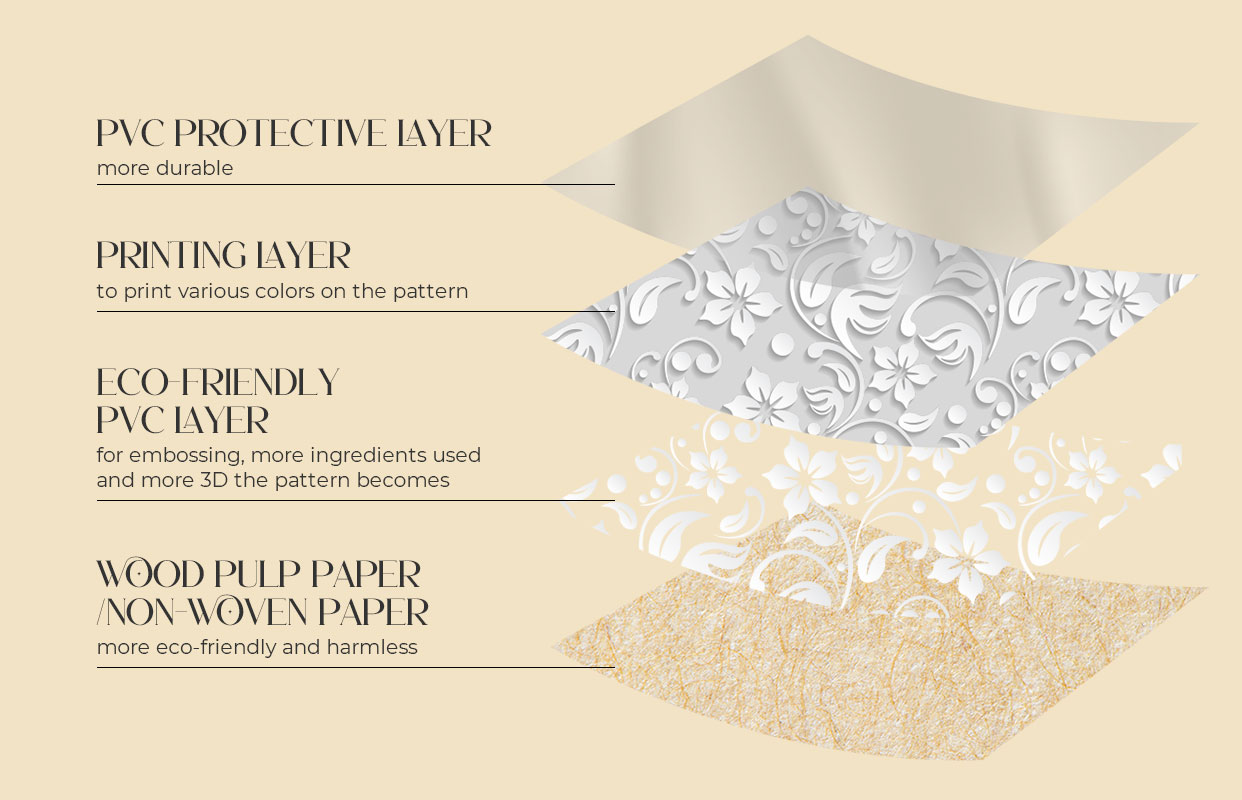 PVC Wallpapers for Durable, Washable High-Traffic InteriorsView PVC wallpaper ranges in vintage, modern, classic, and natural styles, with durable, water-resistant, easy-clean surfaces for kitchens, bathrooms, and busy commercial spaces.View Product → is the category to price against.
Buffer, Batch Numbers and Spare Rolls
For a single domestic room, a buffer of one extra roll is enough. For a hotel floor, a restaurant, or any space where matching paper may be needed again in two years, order ten to fifteen percent extra and confirm that the entire quantity comes from one batch. Batch and dye lot numbers should be written on the order confirmation and kept with the maintenance file, because the same pattern printed in a different run can read as a slightly different shade under corridor lighting.
Store the spare rolls flat, wrapped, and away from damp. Practical removal and long-term maintenance notes, including how to lift a damaged drop without tearing the surrounding paper, are covered in this wallpaper removal and restoration guidance.
To sum up the whole method in one line: measure the tallest ceiling height, add trim and one pattern repeat to get the drop length, divide the roll length by that figure, count how many drops each wall needs, and then add a real buffer on top. That sequence turns a rough area estimate into an order quantity that survives contact with an actual installation.
EXCLUSIVE ACCESS TO PRODUCTS,
OFFERS AND INSPIRATION
-
Quick Links
Wallpapers Customize Our Story Factory News Contact Us -
Contact Us
+86-19157608277 [email protected] Room 509, T2, Fuyi Garden Center, Shangcheng District, Hangzhou City, Zhejiang Province, China

 Eco Friendly Wallpaper Manufacturer Hotel Wallpaper Supplier