
 English
 русский
 Français
 Español
 Deutsch
 عربى
عربى


How Do You Calculate How Much Wallpaper You Need? A Step-by-Step Measuring Method
Content
- 1 The Core Formula: Area Divided by Usable Coverage
- 2 Measuring the Room, Step by Step
- 3 Pattern Repeat: The Number Most People Forget
- 4 A Worked Example: 4 m × 3 m Room, 2.5 m Ceiling
- 5 How the Wallpaper Type Changes Your Buffer
- 6 Six Mistakes That Push the Order Over Budget
- 7 Checking the Order Before You Pay
Divide the total wall area by the usable coverage of one roll, then add 10 to 15 percent for trimming and pattern matching. That is the short answer to how you calculate how much wallpaper you need, and it is accurate enough for most rooms.
The detail is what separates a comfortable order from a stressful one. A 4 m by 3 m room with a 2.5 m ceiling takes about seven rolls of a plain 0.53 m × 10.05 m paper, and roughly nine rolls once a 32 cm straight-match repeat appears in the design. Same room, same walls, two very different invoices. The gap takes about ten minutes with a tape measure, a pencil and a calculator.
The Core Formula: Area Divided by Usable Coverage
Wall area is the easy half: perimeter multiplied by ceiling height. Usable coverage is the slippery half. A standard 0.53 m × 10.05 m roll is 5.3 m² on paper, and nobody ever hangs 5.3 m² from it.
You cut the roll into full-height strips, and whatever is left at the end — often 0.5 m to 1.5 m — is waste, because a strip shorter than the wall height cannot be hung. So work in two steps:
- Strips needed = wall width ÷ roll width, rounded up.
- Rolls needed = strips needed ÷ strips per roll, rounded up.
Strips per roll = roll length ÷ strip length, rounded down. A 2.5 m ceiling gives four strips from a 10.05 m roll, because four strips use 10 m and a fifth would need 12.5 m. Round up for strips, down for strips per roll. Do it the other way and you will order short.
Measuring the Room, Step by Step
Measure Every Wall Separately
Do not multiply floor area by four and call it done. Measure each wall at skirting level and again just under the ceiling, and keep the larger figure. Older rooms and hotel corridors are rarely square, and a 3 cm difference along a 6 m wall can add a whole strip. Take the height in three places — left, centre and right — and use the tallest, because a strip cut 2 cm short cannot be stretched.
Turn Widths Into Strips, Not Square Metres
If a wall is 4.2 m wide and the roll is 0.53 m, you need 4.2 ÷ 0.53 = 7.9, so 8 strips. Offcuts can be reused above a door or beside a window, but only count them if the piece is longer than the wall height and comes from the same batch.
Subtract Openings Only When It Changes the Order
A door of 0.9 m × 2.1 m removes about 1.9 m²; a window of 1.5 m × 1.2 m removes about 1.8 m². Together that is roughly two strips. Installers normally hang the full strip and cut around an opening, because a strip with a hole in it cannot be moved elsewhere. Deduct only when the saving drops you a whole roll, and never deduct a socket.
Pattern Repeat: The Number Most People Forget
The repeat — also written as pattern match or rapport — is the distance before the design starts over. A straight match forces you to cut each strip where the pattern aligns with the strip beside it, so you add up to one full repeat to the strip length. Half-drop designs need half the repeat added.
| Match type | Repeat on the label | Extra length per strip | Working length at a 2.5 m ceiling | Strips from a 10.05 m roll |
|---|---|---|---|---|
| Random or free match | 0 cm | 0 cm | 2.50 m | 4 |
| Straight match | 32 cm | Up to 32 cm | 2.56 m | 3 |
| Straight match | 64 cm | Up to 64 cm | 2.56 m | 3, with more off-cut waste |
| Half-drop match | 64 cm | Up to 32 cm | 2.56 m | 3 |
The jump from four strips per roll to three is a 25 to 33 percent increase in rolls — the entire difference between seven and nine rolls in our example room. The threshold does the damage, not the size of the repeat: a 32 cm repeat and a 64 cm repeat both give three usable strips from a 10.05 m roll at a 2.5 m ceiling, but the larger one throws away more paper.
The repeat is printed on the roll label and in the product specification. If it is missing, measure from the sample: find two identical points in the design, one directly above the other, and take the vertical distance between them.
A Worked Example: 4 m × 3 m Room, 2.5 m Ceiling
Wallpaper: 0.53 m × 10.05 m, straight match with a 32 cm repeat. One door and one window.
- Perimeter = 2 × (4 + 3) = 14 m.
- Strips = 14 ÷ 0.53 = 26.4, rounded up to 27.
- Strip length = 2.5 m + 0.32 m = 2.82 m, rounded up to the next repeat multiple, which is 2.88 m.
- Strips per roll = 10.05 ÷ 2.88 = 3.49, rounded down to 3.
- Rolls = 27 ÷ 3 = 9.
- Openings total about 3.7 m², roughly three strips of coverage. Most installers leave that in the order as a buffer rather than deduct it.
Nine rolls is the number to buy. In US customary units the logic is identical: a double roll of 20.5 in × 33 ft at an 8 ft ceiling yields four strips with a random match and three with an 8 in repeat, and the same rounding rules apply.
How the Wallpaper Type Changes Your Buffer
The substrate decides how forgiving your numbers can be, and it also changes how much waste you can realistically accept.
Nonwoven wallpapers are pasted on the wall rather than the paper, stay dimensionally stable, and can be hung dry. Because they barely stretch, a strip cut to 2.88 m stays 2.88 m, and the strip count you calculated is the strip count you get. That predictability suits long corridors where the pattern has to run continuously.
 Nonwoven Wallpapers for Breathable Residential and Commercial InteriorsFor predictable strip counts and breathable performance, browse Nonwoven Wallpapers in vintage, modern, classic, and natural styles for residential or commercial rooms.View Product →
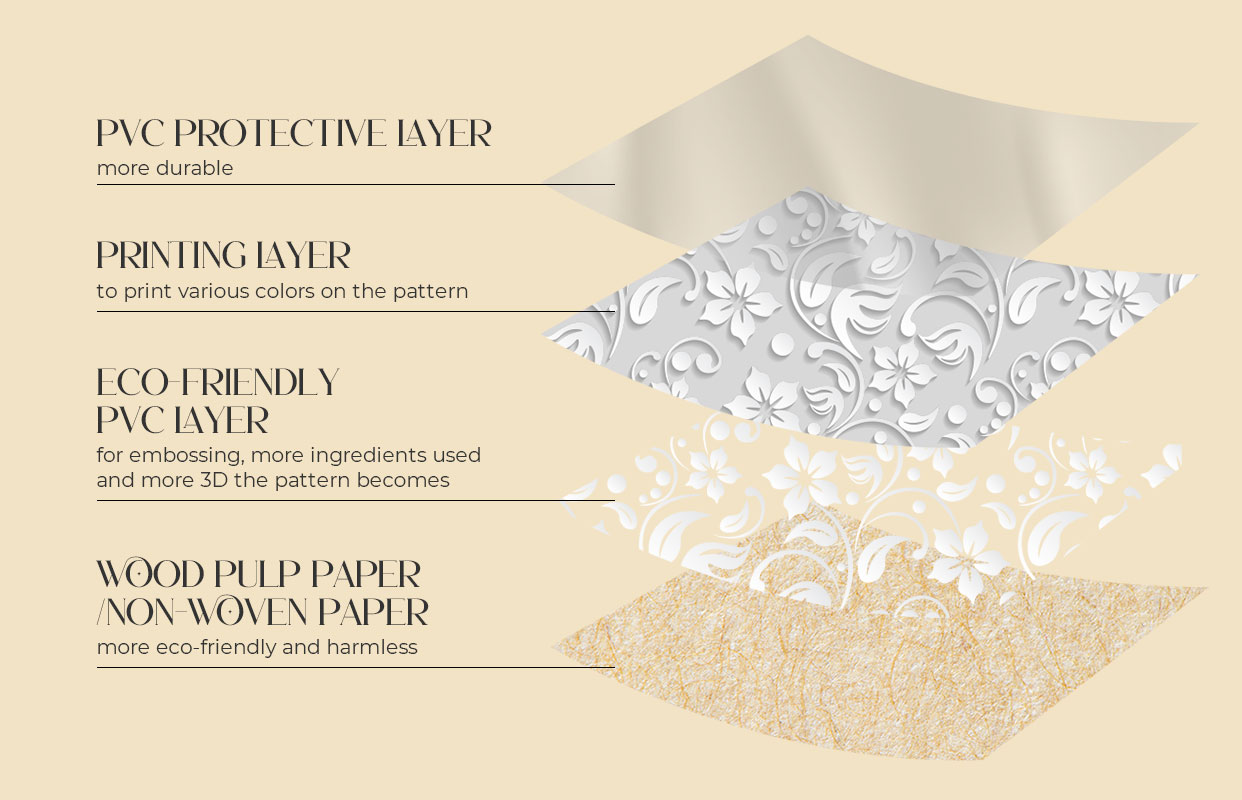
PVC wallpapers are the workhorse of commercial interiors. The vinyl surface resists scuffing and can be wiped down, which matters in lobbies and stairwells where a repaint is not an option. Some ranges come in wider rolls, so confirm the width before you commit to a strip count built around 0.53 m.
 PVC Wallpapers for Kitchens, Bathrooms, and High-Traffic Commercial SpacesFor lobbies and stairwells where washing beats repainting, explore PVC Wallpapers with durable vinyl, easy-clean surfaces, and vintage, modern, classic, and natural styles.View Product →
Peel and stick wallpapers remove a variable from the whole calculation, because no paste and no soaking table are involved. Panels are often sold at fixed widths, so you divide wall width by panel width and round up, exactly as before. Repositioning a dry adhesive panel is easy but not unlimited, so keep the spare panel instead of forcing a misaligned strip into place.
 Peel and Stick Wallpapers for Renters and Quick Interior RefreshesFor no-paste installation and easy repositioning, explore Peel And Stick Wallpapers with removable vinyl options for walls, furniture, and cabinets.View Product →
Six Mistakes That Push the Order Over Budget
- Using floor area instead of wall area. A 12 m² floor can easily carry 40 m² of wall.
- Ignoring the repeat on the label, then discovering the mismatch after the first strip is cut.
- Measuring the height only once, in the middle of the wall.
- Forgetting that the first strip of each run is longer, because the top is trimmed to align the pattern.
- Assuming every roll is 0.53 m wide. Some are 0.70 m, some are 1.06 m, and the strip count changes immediately.
- Buying the final roll from a different batch, then finding the shade differs under daylight.
Checking the Order Before You Pay
Add 10 percent to the calculated roll count as a working margin, round up to the next whole roll, and confirm the batch numbers match across the entire order. If the room has more than one window or a chimney breast, add one extra roll rather than recalculating; a spare roll of the same batch is cheap compared with hunting down a discontinued design later. Browsing finished interiors and wallpaper applications before you commit also helps, because a pattern that looks calm on a sample can feel busy once it covers four walls.
Finally, plan for the day the paper comes down. If the wall was sealed or painted before hanging, removal will be easier than if it was left bare and dusty, and the restoration notes for vinyl wallcoverings are worth reading before you choose a heavy vinyl.
EXCLUSIVE ACCESS TO PRODUCTS,
OFFERS AND INSPIRATION
-
Quick Links
Wallpapers Customize Our Story Factory News Contact Us -
Contact Us
+86-19157608277 [email protected] Room 509, T2, Fuyi Garden Center, Shangcheng District, Hangzhou City, Zhejiang Province, China

 Eco Friendly Wallpaper Manufacturer Hotel Wallpaper Supplier