
 English
 русский
 Français
 Español
 Deutsch
 عربى
عربى


How to Calculate Wallpaper Needed: Roll Count, Waste, and Pattern Matching
Content
Maybe you are remeasuring a bedroom, a rental apartment, or a hotel corridor. The number that matters most is not the size of the wall alone; it is the number of rolls you need to buy. Get it wrong, and you will either be left with expensive unused wallpaper or a half-finished room that cannot be matched to the original dye lot.
The reliable method is simple: measure the wall area, subtract openings with restraint, add waste for trimming and pattern matching, and divide by the usable coverage of one roll. Then round up to the nearest full roll. This guide explains each step so you can place your order with confidence.
Measure the Wall Surface Correctly
Start with a tape measure and record the width of every wall at the height that will be covered. Do not rely only on floor plans; actual dimensions can be different after plastering, leveling, or structural adjustments. The base formula is straightforward:
Wall area = room perimeter x wall height.
For a rectangular room that is 4 m wide and 5 m long with a 2.6 m ceiling, the perimeter is 18 m and the wall area is 46.8 m2. If you prefer feet, the logic is identical: perimeter in feet times wall height in feet gives square feet.
- Measure wall height at several points. Use the maximum height, not the average, because floors and ceilings are not always level.
- Subtract only about 50% of each door and window area. You still need wallpaper to wrap around frames, cut returns, and adjust for corners, so removing the entire opening area will make your estimate too tight.
- Add areas for alcoves, recessed sections, stairwells, and visible strips behind radiators.
- For a room with many openings, use a waste factor closer to 15% instead of 10%.
When you have the wall area, keep it as the starting point for the next step. Do not move directly to the roll count before checking the width and length of the roll you plan to buy.
Know the Usable Coverage of a Roll
Wallpaper rolls are not all the same. A European single roll may be 0.53 m wide and 10.05 m long, giving a nominal area of 5.3 m2. North American wallpaper is often sold as a double roll, commonly 20.5 in wide and 33 ft long, with a nominal area of about 56 sq ft. The printed area is not the same as the usable area because you lose material to trimming, cutting around obstacles, and aligning the pattern.
| Roll format | Nominal area | Usable area after trimming |
|---|---|---|
| European single roll (0.53 m x 10.05 m) | 5.3 m2 | 4.2 to 5.0 m2 |
| North American double roll (20.5 in x 33 ft) | 56 sq ft | 50 to 54 sq ft |
| Peel-and-stick roll (varies by line) | See label | See label |
Roll width matters as much as area. A wider roll means fewer strips, but each strip can be heavier and harder to position without bubbles. A narrower roll gives you more seams, which can make pattern alignment more demanding. Use the actual width in your strip count rather than relying on square footage alone.
Nonwoven wallpaper is a practical choice for many rooms because the material is stable and can be adjusted during hanging. The roll coverage still depends on the printed dimensions, so calculate the same way you would for any other base material.
 Nonwoven Wallpaper Rolls for Accurate Pattern Repeat CalculationThis nonwoven wallpaper collection offers stable material for easy hanging, but exact roll coverage still depends on printed dimensions, making it important to account for pattern repeat when estimating.View Product →
Account for Pattern Repeat and Waste
Pattern repeat is the vertical distance between identical points in the design. If your wallpaper has a repeat, each strip must be cut longer than the wall height so the motif lines up at the seam. That extra length becomes waste, and it cannot be ignored.
A practical waste allowance based on pattern type is a useful starting point:
- No repeat or random match: add 10%.
- Small repeat up to 20 cm or 8 in: add 15%.
- Large repeat or drop match: add 20% to 25%.
For a more precise calculation, use the strip method. Count the number of strips you need around the room by dividing the perimeter by the roll width and rounding up. Then calculate how many strips you can get from one roll:
Strips per roll = roll length divided by (wall height + pattern repeat + trim allowance).
Always round this number down. Even if the result is 3.9 strips, you can only cut three full strips from that roll. The leftover is not long enough for the next complete strip.
For example, with a 0.53 m wide roll, a room perimeter of 18 m requires 34 strips. If the wall height is 2.6 m, the pattern repeat is 0.26 m, and the trim allowance is 0.05 m, each strip needs 2.91 m. A 10.05 m roll gives 3 usable strips. That means you need 12 rolls for the room. Without the repeat, the same wall area would have needed fewer rolls, which is why pattern repeat is one of the biggest reasons estimates miss.
Bathrooms and kitchens often use a scrubbable PVC wallcovering because it holds up to moisture and cleaning. The pattern repeat still controls the waste, so measure it the same way even when the surface treatment is more durable.
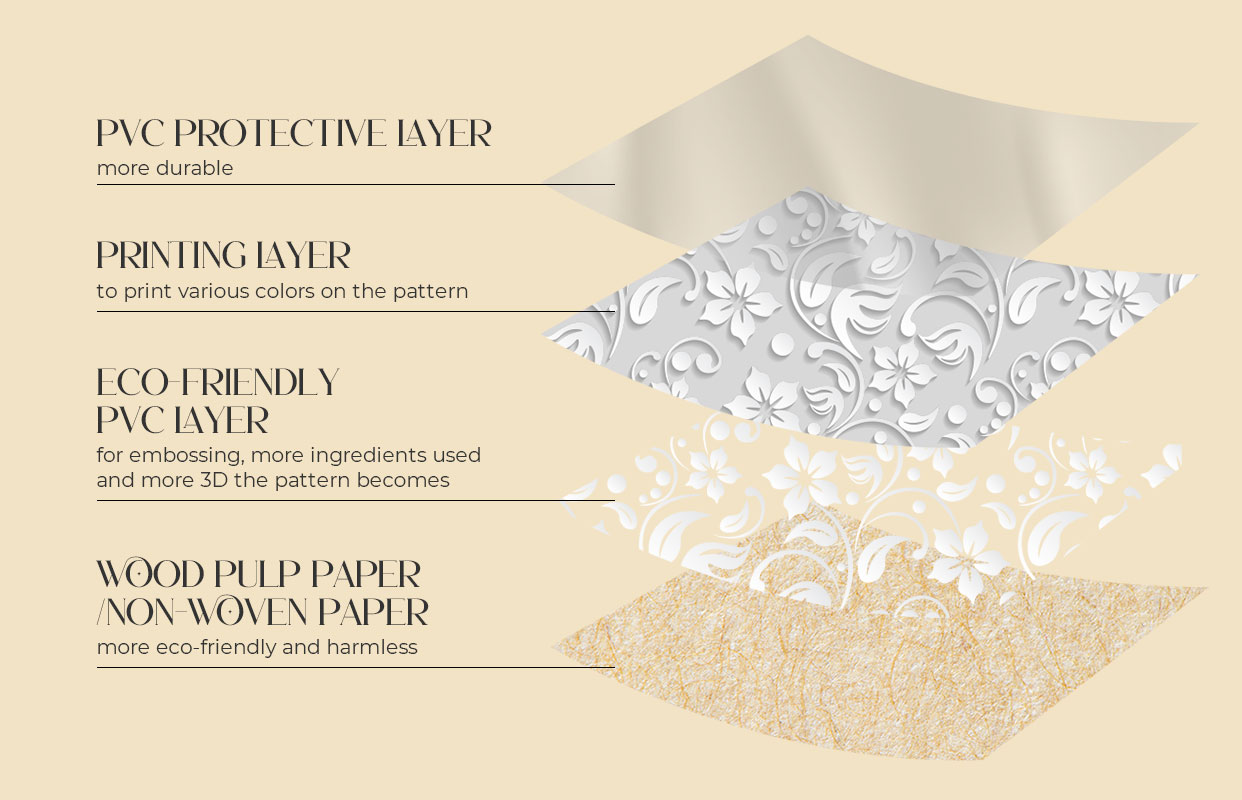 Scrubbable PVC Wallpaper with Durable Surface for Wet AreasThis PVC wallpaper resists moisture and stains, making it suitable for kitchens and bathrooms. Its pattern repeat still affects waste, so measure carefully even with its durable surface.View Product →
Calculate the Number of Rolls
Once you know the wall area and the usable coverage of one roll, the final calculation is simple:
Rolls needed = (wall area x waste factor) divided by usable coverage per roll.
Round up to the next whole roll. A result of 8.3 rolls means you need 9 rolls. A result of 8.01 rolls also means 9 rolls. Do not round down just because you are close; a short strip in the middle of a project is far more expensive than one extra roll.
Example calculation
- Measure a room with a perimeter of 48 ft and a wall height of 9 ft. The total wall area is 432 sq ft.
- Subtract half the area of doors and windows instead of all of it. If the openings total 84 sq ft, subtract 42 sq ft. The adjusted area is 390 sq ft.
- Add 15% for trimming and small pattern match: 390 x 1.15 = 448.5 sq ft.
- Divide by the usable coverage of a North American double roll, about 54 sq ft: 448.5 divided by 54 = 8.3 rolls.
- Round up and order 9 double rolls.
The same formula works in metric. If your wall area is 42.8 m2 and you add 15% waste, you get 49.2 m2. Dividing by 5.3 m2 per roll gives 9.3 rolls, so you order 10 rolls.
Peel-and-stick wallpaper is calculated the same way, but its roll width and repeat can be different from traditional rolls. Check the label because some peel-and-stick products are sold in shorter rolls or narrower widths.
 Peel-and-Stick Wallpaper with Varied Roll Widths and RepeatsThis peel-and-stick wallpaper requires careful roll label checking because its width and repeat can differ from traditional rolls, helping you avoid miscalculating coverage in large projects.View Product →
Order Enough, but Do Not Forget the Dye Lot
For a large project, especially a hotel or multi-room install, the biggest risk is not the arithmetic; it is the dye lot. Wallpaper from different production batches can look different even when the product code is the same. The color shift may be subtle, but once the wallpaper is on the wall it becomes obvious. Order all rolls for the project at one time and confirm that every roll carries the same batch or dye lot number.
Buying one extra roll is a normal part of professional planning. After installation, keep that roll unopened. If a wall is damaged later, you will avoid the problem of trying to find a matching roll from a different production run.
Commercial projects require the same measurement discipline, but with even less room for error. The specification process for high-end wallcoverings usually includes a clear waste allowance because delays and mismatches are costly.
For most homeowners, a one-roll buffer is enough. If you are covering an entire house, ask the supplier to confirm the total number of rolls needed for each room based on the exact roll width and repeat. A supplier that manufactures its own wallpaper can normally give you a quick estimate, but you should still verify the assumptions: wall height, perimeter, pattern repeat, and waste factor.
Calculating wallpaper needed is not a guess. It is a simple sequence of measurement, pattern allowance, and roll coverage. Measure carefully, round up, and leave a small buffer. That is the difference between a smooth installation and an avoidable delay. If you want style direction before measuring, browse our wallpaper inspiration ideas and then apply the same roll-count method to the space you need to cover.
EXCLUSIVE ACCESS TO PRODUCTS,
OFFERS AND INSPIRATION
-
Quick Links
Wallpapers Customize Our Story Factory News Contact Us -
Contact Us
+86-19157608277 [email protected] Room 509, T2, Fuyi Garden Center, Shangcheng District, Hangzhou City, Zhejiang Province, China

 Eco Friendly Wallpaper Manufacturer Hotel Wallpaper Supplier